Raven Beck
Menu +
Home Outline Resources Contact
Ask Anything+
Ask A Question Answered Questions
Home Outline Resources Contact
Ask Anything+
Ask A Question Answered Questions

Strong Foundations / Reading Guide

A Beginner's Bible Reading Order

R.C. Sproul's counsel for first-time readers: build the framework before trying to absorb every detail.

Start The Guide
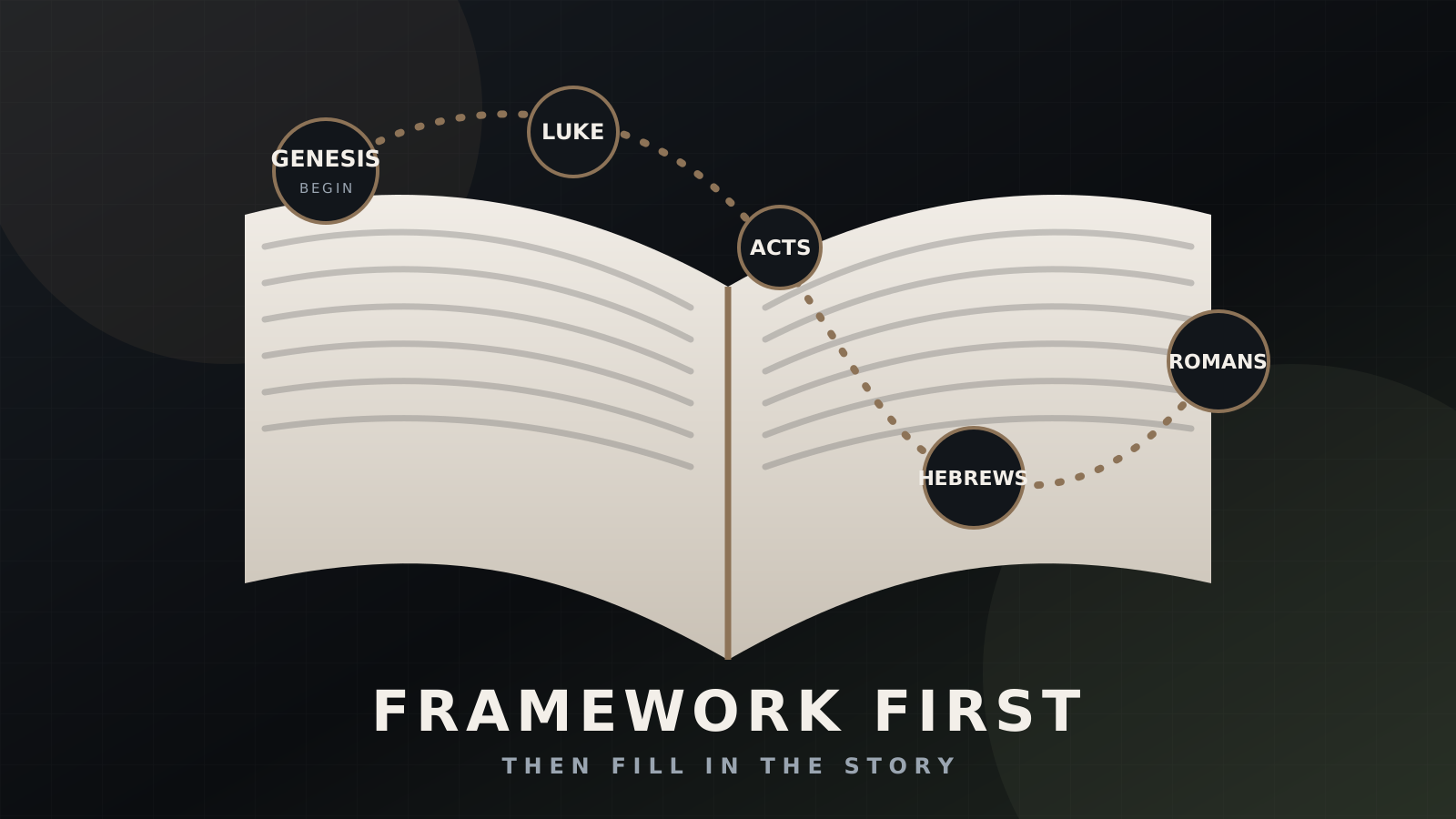
An open Bible with a reading path through Genesis, Luke, Acts, Hebrews, and Romans

The Main Idea

Framework First

Beginning at Genesis and pressing straight through to Revelation can overwhelm a new reader. Genesis and Exodus move quickly; then the unfamiliar laws and worship of ancient Israel arrive before the reader has a framework for understanding them.

Sproul's proposal is not to ignore difficult books. It is to begin with a smaller selection that gives you the Bible's storyline and principal kinds of literature. Once the skeleton is in place, return to the remaining books and fit their details into the larger story.

Get the broad story. Meet the major kinds of writing. Then read the whole Bible with somewhere to place what you find.

If You Begin Today

Start With Luke

Luke is accessible to a new reader and leads directly into Acts, its sequel. From there, sample teaching, church life, pastoral care, and theology.

LukeActsEphesians1 Corinthians1 Peter1 TimothyHebrewsRomans

01 / The Story

Luke + Acts

Follow Jesus' life and the mission of the early church as one continuous account.

02 / Paul's Teaching

Ephesians + 1 Corinthians

Meet Paul's teaching and see how it addresses practical issues in the church.

03 / Pastoral Care

1 Peter + 1 Timothy

Hear Peter's pastoral concern and Paul's instruction for life and leadership.

04 / Go Deeper

Hebrews + Romans

Graduate to two of the New Testament's richest presentations of Christ and the gospel.

After Romans, return and complete the remaining New Testament books.

Old Testament

Build The Skeleton

Five stages take you through history, prophecy, wisdom, worship, and finally the remaining books.

  1. 01

    Build The Historical Framework

    Genesis → Exodus → Joshua → Judges → 1 Samuel → 2 Samuel → Ezra → Nehemiah

    Trace creation, the patriarchs, the exodus, Canaan, the judges, the kingdom, exile, and return.

  2. 02

    Meet The Prophets

    Amos → Hosea → Jeremiah

    Begin with two short Minor Prophets, then move into Jeremiah as an accessible introduction to the longer prophets.

  3. 03

    Sample Wisdom Literature

    Ecclesiastes → Song of Solomon

    These two relatively short books introduce the Old Testament's wisdom literature. Save Job for later.

  4. 04

    Read Its Songs And Practical Wisdom

    Psalms → Proverbs

    Enter the prayers, songs, worship, reflection, and concentrated wisdom of the Old Testament.

  5. 05

    Fill In The Framework

    Read the remaining Old Testament books

    Now return to the Law, Job, the remaining history, and the other prophets with a structure that helps you see where they fit.

A Sustainable System

Read Both Testaments Together

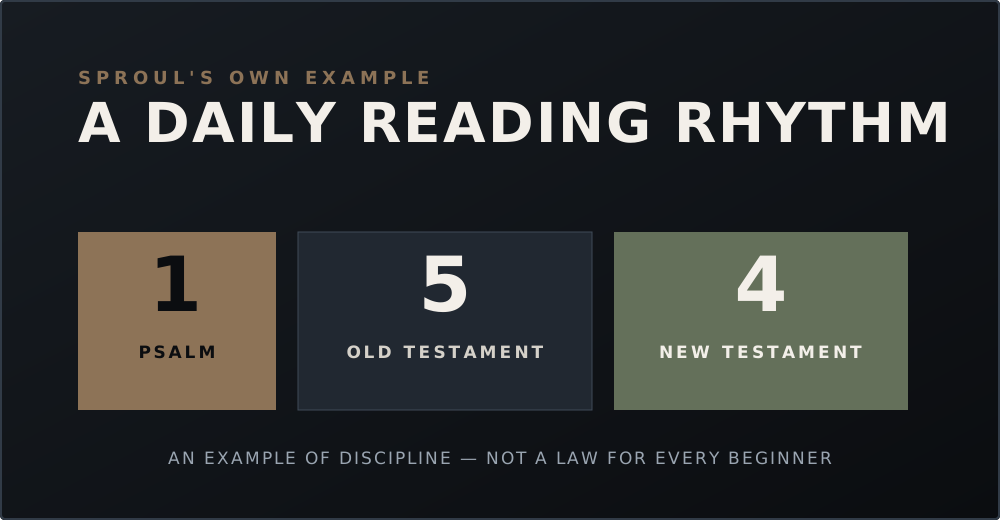
Sproul once used a daily rhythm of one Psalm, five other Old Testament chapters, and four New Testament chapters. He offered this as an example of discipline, not a ten-chapter law for every beginner.

The important thing is to choose a deliberate, sustainable system instead of relying on occasional enthusiasm. Read enough each day to keep moving and understanding.

Example daily rhythm: one Psalm, five Old Testament chapters, and four New Testament chapters

Why Study Matters

A Disciple Is A Learner

In 2 Timothy 3:12–17, Scripture equips God's people through teaching, reproof, correction, and training in righteousness. Bible study is not an optional hobby for unusually academic Christians; it belongs to ordinary discipleship.

If discipline is difficult, borrow some. Join a class, Bible study, or fellowship where other people will help you keep learning.

How To Read

Be A Participant

Do not remain an untouched spectator. Enter the human situation of the passage. Ask what is happening, what the people are facing, and how the truth reaches your life today.

Personal involvement is not permission to make the Bible mean whatever we want. First listen to what the passage says in its own setting; then let that truth address you where you live.

The Counsel In Brief

Keep Going

Do not confuse reading the Bible in its printed order with reading it wisely for the first time. Meet Jesus in Luke, follow the early church into Acts, and build a framework that gives difficult books somewhere to fit. Then return and read the whole Bible with greater understanding.

The goal is not merely to check off chapters. The goal is to become a learner—hearing, understanding, and being equipped by the Word of God.

About This Guide

This page is a condensed, lightly edited presentation of R.C. Sproul's teaching in Renewing Your Mind — How to Study the Bible. It is a paraphrase and organization of his remarks, not a verbatim article written by Sproul. The main discussion occurs approximately 13:22–24:16 in the supplied transcript.

Back To Resources Ask Anything